English Self-Learning Resources
► English Learning Resources — Cool English
https://www.coolenglish.edu.tw/
The Elementary and Junior High School Section offers a wide range of courses covering listening, speaking, reading, writing, vocabulary and grammar, games, remedial learning resources, and a dedicated section for the Comprehensive Assessment Program for Junior High School Students (CAP). These diverse and comprehensive learning materials aim to develop students' overall English language proficiency.
The Senior High and Vocational High School Section organizes its courses into nine categories based on English proficiency indicators: Listening, Speaking, Reading, Writing and Translation, Vocabulary, Grammar, Past Examination Papers, Games, and Senior High School Textbook Enhancement Resources. The platform offers one of the most extensive and comprehensive collections of English learning resources in Taiwan.
The Higher Education Section features ten major categories: English as a Medium of Instruction (EMI) / English for Academic Purposes (EAP) / English for Specific Purposes (ESP), English-Language Academic Textbooks, English Proficiency Test Preparation, Job-Seeking and Workplace English, AI-Assisted Learning Tools, English through Films, Television and News, Learning Strategies and Literacy Skills, Everyday and Travel English, English Reading Resources, and English Learning Games. These resources aim to enhance students' academic research capabilities, career competitiveness, and international communication skills.
► English Proficiency Assessment — English Self-Assessment System
https://www.testmyenglish.edu.tw/
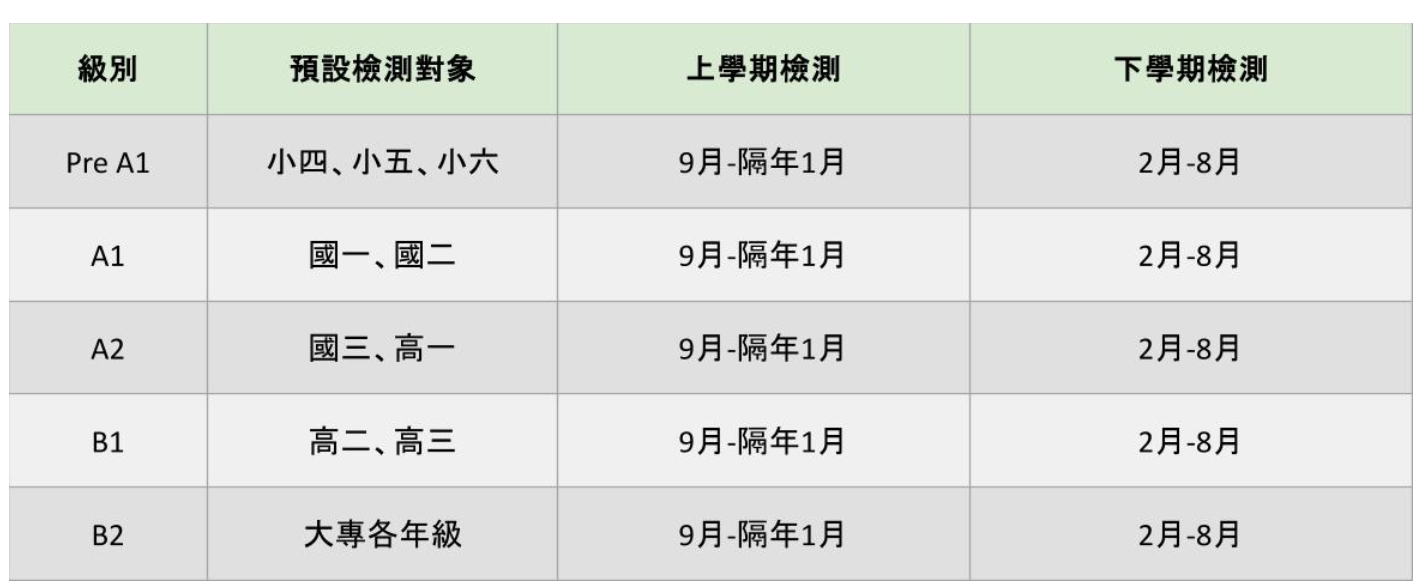
The English Self-Assessment System provides five proficiency levels—Pre-A1, A1, A2, B1, and B2—based on students' educational stages:
Pre-A1: Elementary school students in Grades 4–6
A1: Junior high school students in Grades 7–8
A2: Students in Grade 9 of junior high school through Grade 10 of senior high school
B1: Senior high school students in Grades 11–12
B2: Undergraduate and graduate students
The first four proficiency levels (Pre-A1, A1, A2, and B1) include five assessment components: Vocabulary, Listening, Reading, Speaking, and Writing. The B2 level includes four assessment components: Listening, Reading, Speaking, and Writing.
The assessment items are designed around familiar, real-life situations and topics relevant to students' daily experiences. By incorporating both local contexts and international perspectives, the system helps students effectively assess their English proficiency and develop the language skills expected at each learning stage.
The estimated testing durations are presented in the table below.